Dog UTI Home Remedies: What Actually Works and What to Skip
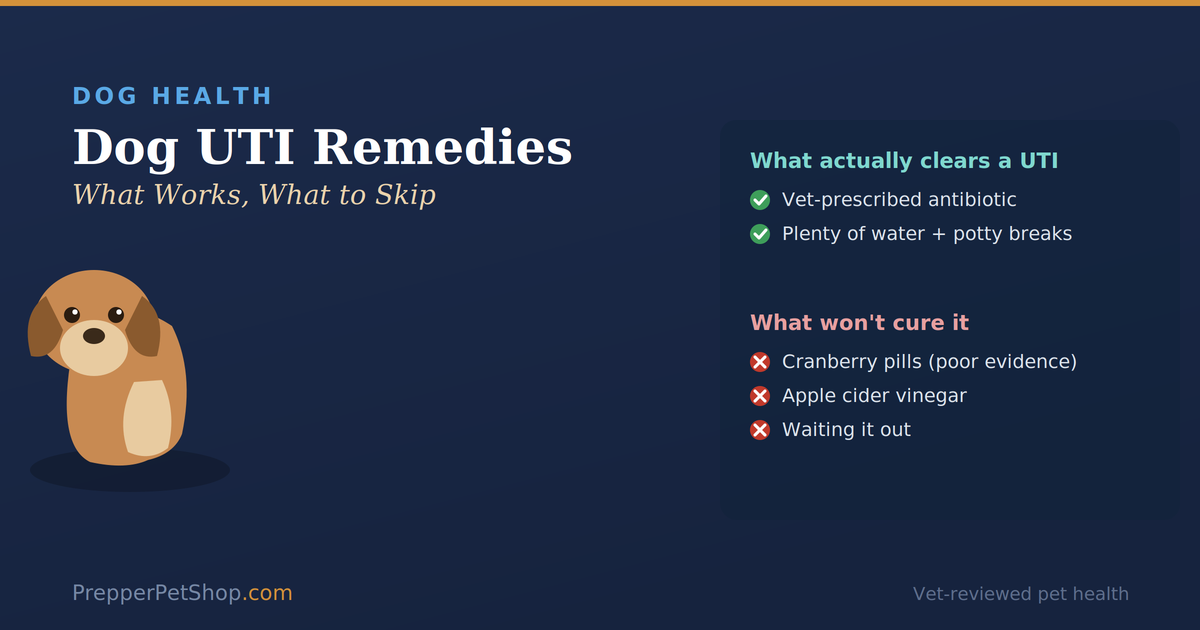
We wrote this because searching "dog UTI home remedies" turns up a wall of articles pushing cranberry pills and vinegar as cures, and that advice can leave a dog in pain with a worsening infection. Here's the vet-reviewed reality: supportive home care is real and worth doing, but it's a supporting role. This guide separates what actually helps from what to skip, and flags when to stop reading and call a vet.
What a dog UTI actually is
A UTI is usually a bacterial infection of the bladder (bacterial cystitis). Bacteria, most often E. coli from your dog's own gut and skin, travel up the urethra, reach the bladder, multiply, and irritate the lining, which drives every symptom.2 The key fact home-remedy articles skip: an infection is a living, multiplying population of bacteria. To clear it reliably you have to kill those bacteria, and that's what a prescribed antibiotic does. No amount of water, cranberry, or vinegar reliably sterilizes an infected bladder.2
Symptoms to watch for
- Frequent urination, often small amounts, or straining to go.
- Blood-tinged or cloudy urine, sometimes with a strong smell.
- Accidents in a house-trained dog.
- Licking the genital area more than usual.
- Signs of discomfort: whining while urinating, restlessness.
Female dogs and older dogs are at higher risk, partly because females have a shorter urethra closer to the anus.1
What genuinely helps at home (supportive care)
These don't replace the vet, but they ease discomfort and support recovery once treatment is underway. And help prevent the next one:
- More water. Constant fresh water, and moisture-rich food if your vet agrees, so the bladder flushes more often.
- Frequent potty breaks. A bladder that empties often gives bacteria less time to multiply.
- Good hygiene. Keep the genital area clean, especially in long-haired or overweight dogs.
- Finish the antibiotics. Give every dose on schedule and complete the full course, stopping early is a top cause of relapse and resistance.
The honest evidence tiers
Reliable: vet-prescribed antibiotic (ideally culture-guided), more water, frequent urination, good hygiene.
Weak / adjunct only (ask your vet): cranberry and D-mannose supplements, veterinary references rate the evidence as poor, so treat them as possible preventive helpers, not treatment.13
Skip: apple cider vinegar, "immune-boost" cure claims, and waiting it out.
What to skip — and why
- Cranberry as a cure. Its proanthocyanidins can interfere with E. coli sticking to the bladder wall in theory, but the Merck Veterinary Manual is explicit that evidence to support cranberry for treating UTIs in animals is lacking.3 Possible minor preventive role, not a treatment.
- Apple cider vinegar. No good evidence it clears a UTI; can upset the stomach.
- Leftover or human antibiotics. Wrong drug/dose/duration fails to clear the infection and breeds resistance. And some human meds are unsafe for dogs.
- "Waiting it out." Bladder infections rarely self-resolve reliably and can ascend to the kidneys.
How the vet diagnoses and treats it
The gold standard is a urine culture with susceptibility testing, which identifies the exact bacteria and the antibiotic that will actually work — avoiding guesswork and resistance.4 For a first, uncomplicated infection, some vets start an appropriate antibiotic based on urinalysis; recurrent or complicated cases really benefit from culture, sometimes with a follow-up culture to confirm a true cure.1 Treatment centers on a targeted antibiotic course, with everything else (water, comfort, hygiene) in support — the approach recommended by the Merck Veterinary Manual and ISCAID guidelines.2
If cost is the worry
A vet visit and a urine test can feel like a lot when money's tight, but a UTI left to worsen (or a kidney infection) costs far more. If cost is the barrier, see our guides on what vet visits cost and organizations that help with vet bills — low-cost clinics and telehealth options can make diagnosis and antibiotics affordable.
Preventing the next UTI
- Fresh water always, and frequent chances to urinate.
- Keep the genital area clean; groom long-haired dogs around the area.
- For recurrent UTIs, ask your vet to look for underlying causes — bladder stones, anatomy, or metabolic disease — since repeats usually have a driver.1
Frequently asked questions
Can I treat my dog's UTI at home without a vet?
You can't reliably cure a true bacterial UTI at home — it needs a vet-selected antibiotic. Home care (water, frequent potty breaks, hygiene, finishing the course) is supportive and eases discomfort but doesn't replace the antibiotic.
Does cranberry cure a dog UTI?
No. Evidence for cranberry treating animal UTIs is poor per veterinary references. It may have a minor preventive role if your vet approves, but it's not a cure.
Will apple cider vinegar help?
No good evidence it helps, and it can irritate the stomach. Skip it and see a vet.
What are the symptoms?
Frequent or strained urination, small amounts, bloody/cloudy urine, accidents, and genital licking. Straining with little output is urgent — possible blockage.
How does a vet treat it?
Ideally a urine culture to pick the right antibiotic, then a targeted course. Uncomplicated cases may start on urinalysis; recurrent ones benefit from culture and a follow-up check.
How long to clear up?
Often better within days, but finish the full course — stopping early causes relapse and resistance. Complicated cases need longer, sometimes a follow-up culture.
What if it's untreated?
It can ascend to the kidneys, contribute to stones, and cause ongoing pain, and rarely self-resolves reliably. Waiting it out is a gamble.
Can I use leftover/human antibiotics?
No — wrong drug/dose breeds resistance and may not work, and some human meds are unsafe for dogs. Get a proper prescription.
How we reviewed this article
This guide follows the Merck Veterinary Manual, ISCAID urinary-infection guidelines, and university veterinary sources rather than the home-remedy marketing that dominates this topic. Every clinical claim is numbered to a source below, and we deliberately state where the evidence is weak (cranberry, D-mannose) rather than overselling it. This article was medically reviewed by Dr. Marc Dhumeaux (DVM, Dip. ACVIM & ECVIM-CA (Small Animal Internal Medicine)) on September 13, 2026. The reviewer verified the clinical accuracy of the guidance; PrepperPetShop is responsible for the final published text.
Sources & references
- Merck Veterinary Manual. Bacterial Cystitis in Small Animals. Risk factors, culture as gold standard, poor evidence for cranberry/D-mannose/probiotics, recurrence workup. merckvetmanual.com
- Merck Veterinary Manual. Pharmacotherapeutics in Bacterial UTIs in Animals. E. coli most common; culture + susceptibility; cranberry evidence lacking; antibiotic-centered treatment. merckvetmanual.com
- Veterinary clinical guidance synthesizing Merck + ISCAID + Cornell. Home Remedies for Dog UTI. Antibiotic as the only reliable cure; supportive-care tiers; cranberry as weak adjunct. webvet.com
- Antibiotic Stewardship study, small-animal UTI (peer-reviewed). Culture/MIC-guided therapy; common uropathogens; resistance considerations. ncbi.nlm.nih.gov
- Peer-reviewed review of natural UTI therapeutics: cranberry proanthocyanidins mechanism and the limits of the evidence. ncbi.nlm.nih.gov
- Dog UTI treatment overview aligning with Merck/ISCAID/Cornell: antibiotic-centered, supportive care, finish the course. webvet.com
Sources current as of September 2026. Educational content, not a substitute for veterinary care. Urinary signs deserve a prompt veterinary diagnosis.