Dog Ate Chocolate? Here's What to Do Right Now
If you just found the wrapper, you want two things fast: is this dangerous, and what do I do. This guide answers both, a real way to gauge the risk from what your dog actually ate, then the steps to take, using veterinary toxicology sources rather than vague "call your vet" advice. (You should call your vet; this helps you know how urgently and what to tell them.)
Why chocolate is toxic to dogs
The culprit is theobromine (plus some caffeine), a stimulant in the methylxanthine family. Dogs metabolize it far more slowly than humans: a half-life around 17.5 hours in dogs versus a few hours in people. So it builds up to levels that overstimulate the heart and nervous system.5 That slow clearance is also why signs can last a day or more and why waiting is risky.
Is it dangerous? Gauge the dose
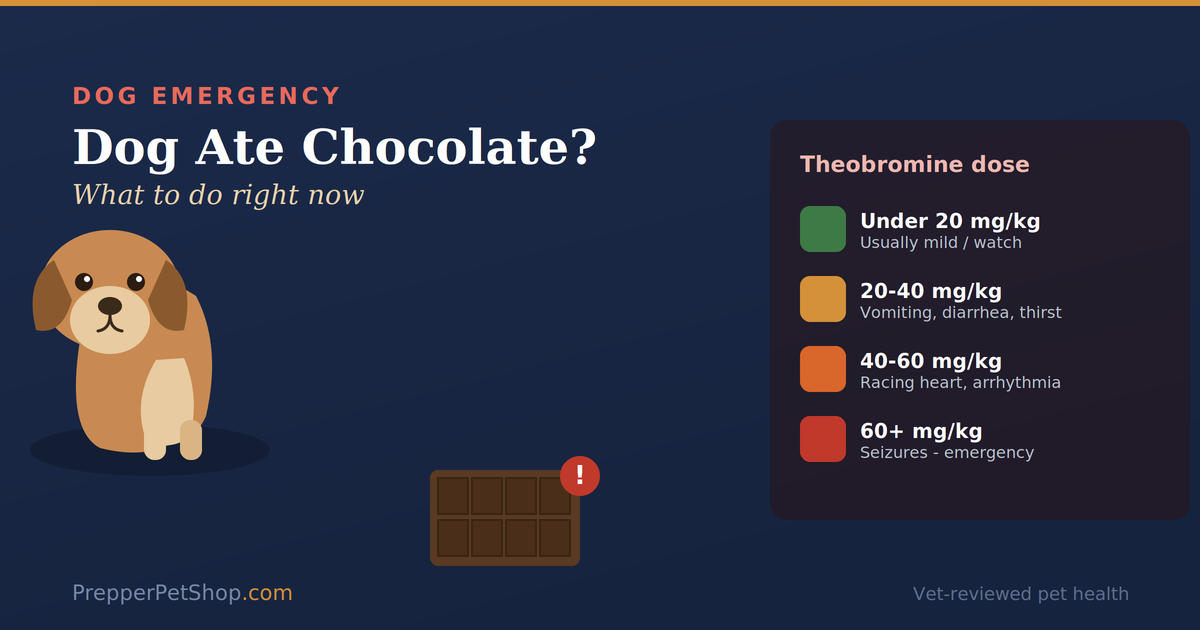
Toxicity is about theobromine per kilogram of body weight, which depends on the type of chocolate as much as the amount. The veterinary thresholds:1
| Theobromine dose | What to expect |
|---|---|
| ~20 mg/kg | Mild signs: vomiting, diarrhea, excessive thirst, restlessness |
| 40–50 mg/kg | Cardiac effects: racing heart, abnormal rhythm |
| ≥ 60 mg/kg | Seizures, a true emergency |
| 100–200 mg/kg | Reported lethal range (LD50) |
And theobromine content varies enormously by chocolate type, this is the number that matters most:3
| Chocolate type | Theobromine (approx.) | Relative danger |
|---|---|---|
| White chocolate | ~1 mg/oz | Negligible (but fatty) |
| Milk chocolate | ~60 mg/oz | Moderate |
| Semi-sweet / dark | ~150–260 mg/oz | High |
| Baking chocolate | ~450 mg/oz | Very high |
| Cocoa powder | highest | Very high |
Symptoms and the timeline
Signs typically appear 2–12 hours after eating and can last 12–36 hours (up to 72 in severe cases).4 In rough order of severity:
- Early / mild: vomiting, diarrhea, excessive thirst, restlessness, panting.
- Moderate: increased urination, a fast or pounding heart, hyperactivity, mild tremors.
- Severe: muscle tremors, abnormal heart rhythm, high body temperature, seizures, collapse.6
Because absorption is slow, a dog that seems fine in the first hour can still be building toward trouble, the timeline is exactly why "wait and see" is the wrong move for a meaningful dose.
What to do, step by step
Step 1, Gather the facts
Before you call, note the type of chocolate (check the wrapper: "% cocoa" and "baking/dark/milk"), how much (weight or a good estimate), when it was eaten, and your dog's weight. Save the wrapper. These four facts let the vet calculate the risk in seconds.
Step 2. Call, don't wait
Phone your veterinarian, the nearest emergency clinic, or a pet poison line (in the US, the ASPCA Animal Poison Control Center or the Pet Poison Helpline). Tell them the four facts. They'll tell you whether to monitor at home or come in — and if to come in, early treatment is far more effective than late.
Step 3 — Don't self-treat
Do not induce vomiting unless the vet directs you to. Done at the wrong time or in the wrong dog it can cause harm (aspiration, or worse in an already over-stimulated dog).6 Don't give human medications. Just get expert direction first.
Step 4 — What the vet may do
If your dog needs treatment, the vet may induce vomiting (if it's early and appropriate), give activated charcoal to block further absorption (sometimes repeated, because theobromine recirculates), provide IV fluids to support the heart and speed excretion, and give medications for heart rhythm or seizures as needed, with monitoring.4 Most dogs treated promptly recover fully.
How worried should you actually be?
Take it seriously, but keep perspective: while chocolate is one of the most common dog poisonings, it's rarely fatal with care. One large veterinary database recorded only 5 fatal cases out of 1,000 canine chocolate cases with follow-up, and about half of dogs stayed asymptomatic.4 The danger is real and rises steeply with dark/baking chocolate, small dogs, and delay — but a milk-chocolate nibble in a large dog is usually a monitor-at-home situation once the vet has run the numbers.
Prevention
- Store all chocolate — baking supplies especially — in closed, high cabinets, and be extra vigilant around holidays.
- Keep cocoa-bean-hull mulch out of yards with dogs; it's toxic too.1
- Teach a reliable "leave it," and tell guests and kids not to share.
- Keep your vet's number and a pet poison line saved in your phone now, before you need them.
Frequently asked questions
My dog ate chocolate — what do I do right now?
Note the type, amount, and time, estimate the theobromine dose from type and your dog's weight, and call your vet or a poison line right away — especially for dark/baking chocolate, a large amount, or a small dog. Act before symptoms appear, and don't induce vomiting unless told to.
How much chocolate is toxic?
It's about theobromine per body weight: mild signs ~20 mg/kg, cardiac 40–50, seizures 60+, lethal 100–200. Baking chocolate (~450 mg/oz) is far more dangerous than milk (~60 mg/oz), so a small amount of baking chocolate can equal a large amount of milk chocolate.
How long until symptoms show?
Usually 2–12 hours, lasting 12–36 (up to 72 in severe cases), because dogs clear theobromine slowly. That slow onset is why you act early rather than wait.
Is white chocolate dangerous?
Barely, for theobromine (~1 mg/oz), but it's high in fat and sugar and can still cause stomach upset or pancreatitis.
Should I make my dog vomit?
Only if a vet tells you to. Done wrong it can cause harm; call for direction first.
What if it had raisins or xylitol?
More urgent — raisins can cause kidney failure and xylitol causes dangerous low blood sugar and liver failure at tiny doses. Call immediately regardless of the chocolate amount.
Can a dog die from chocolate?
Possible but rare with prompt care — about 5 deaths per 1,000 cases in one large database, with half asymptomatic. Risk rises with dark/baking chocolate, small dogs, and delay.
When is it an emergency?
Seizures, collapse, tremors, a racing or irregular heartbeat, a large amount of dark/baking chocolate, a small dog, or raisins/xylitol involved — go to an emergency vet now.
Can cats get chocolate poisoning?
Yes, with a similar toxic threshold, though cats rarely eat it. Treat it with the same urgency.
How we reviewed this article
This guide is built from veterinary toxicology sources — the Merck Veterinary Manual, ASPCA Animal Poison Control, university veterinary colleges, and the Veterinary Poisons Information Service — not general web advice. Every dose figure and clinical claim is numbered to a source below and presented as a reference range with its caveats, never as a substitute for calling your vet, who can calculate your specific dog's risk and direct treatment. This article was medically reviewed by Dr. Marc Dhumeaux (DVM, Dip. ACVIM & ECVIM-CA (Small Animal Internal Medicine)) on September 12, 2026. The reviewer verified the clinical accuracy of the guidance; PrepperPetShop is responsible for the final published text.
Sources & references
- Merck Veterinary Manual. Chocolate Toxicosis in Animals. Theobromine thresholds (20/40–50/60 mg/kg), LD50 100–200 mg/kg, methylxanthine content by type, toxicity calculator, cocoa-hull mulch. merckvetmanual.com
- American College of Veterinary Pharmacists. Chocolate. Toxic consumption ~250 mg/kg dogs / 200 mg/kg cats; signs; 2–4 hr onset. vetmeds.org
- Purdue University College of Veterinary Medicine. Chocolate Toxicity in Dogs. Theobromine by chocolate type (milk 60, baking 450 mg/oz), example dose math, mechanism. vet.purdue.edu
- Veterinary Poisons Information Service (VPIS). Revised treatment doses for chocolate. Thresholds, white-chocolate low risk, ~5 fatalities / 1,000 cases, ~half asymptomatic. vpisglobal.com
- Chocolate toxicity clinical references on methylxanthine metabolism — canine theobromine half-life ~17.5 hrs vs 2–3 hrs in humans; slow absorption/recirculation. (Merck; toxicology summaries.) merckvetmanual.com
- IndeVets / veterinary clinical guidance. Treating Chocolate Toxicosis in Dogs. Onset 2–12 hrs, duration 12–72 hrs, supportive care (fluids, charcoal, antiemetics), cautions. indevets.com
Sources current as of September 2026. Educational content, not a substitute for veterinary care. If your dog has eaten chocolate, contact your veterinarian or a pet poison control line.