Goldfish Diseases: Identify and Treat the Common Problems
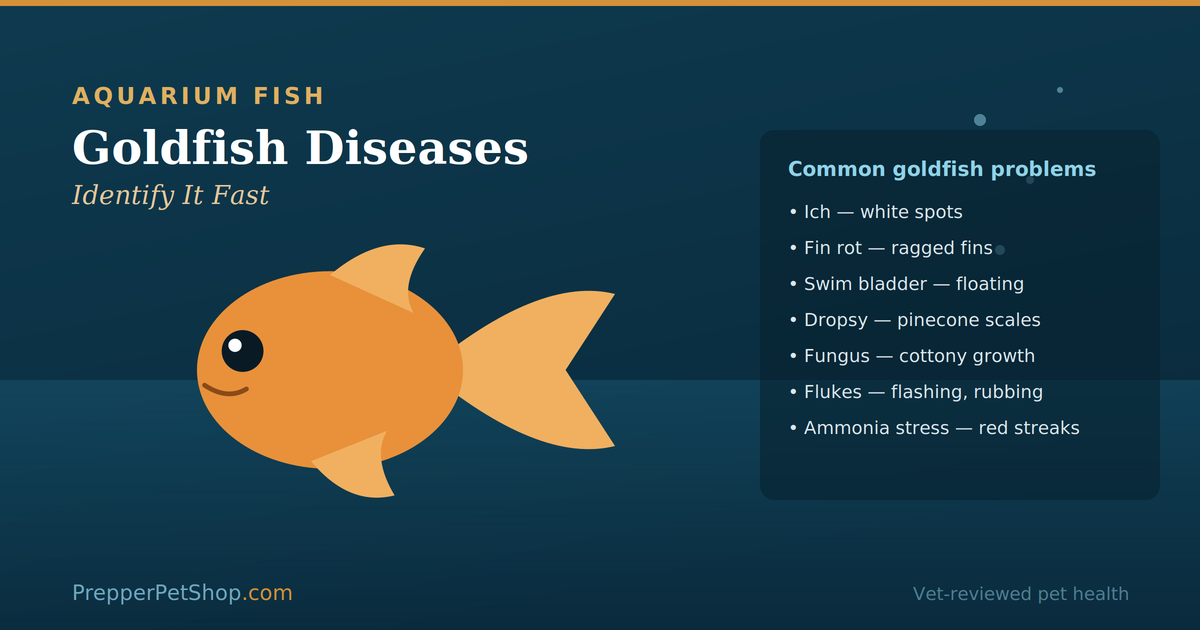
Goldfish can live well over a decade in the right setup, but they're routinely kept in conditions that make them chronically sick. This guide helps you recognize the common problems, understand why they happen, and act in the right order. Starting, almost always, with water and tank size.
Identify it: the common goldfish diseases
| Disease / sign | Key signs | Notes |
|---|---|---|
| Ich (white spot) | Tiny white "salt grain" spots; flashing | Contagious parasite; treat promptly |
| Fin rot | Frayed/receding fins, discolored edges | Bacterial, stress-driven. Full guide |
| Swim bladder disorder | Floating, sinking, tipping sideways | Very common in fancy goldfish; often diet/water related |
| Dropsy | Swollen body, pineconed scales | Serious internal illness; honest odds in our dropsy guide |
| Fungus | Cottony white/grey growths | Often secondary to injury or poor water |
| Flukes / parasites | Flashing, rubbing on decor, clamped fins | Contagious; needs targeted treatment |
| Ammonia stress/poisoning | Red streaks in fins/body, gasping, lethargy | A water emergency, test and change water now |
Why goldfish get sick: it's usually the tank
Goldfish are high-waste fish that grow far larger than people expect and need large, heavily filtered tanks or ponds, not bowls.2 In an undersized, under-filtered setup, ammonia and nitrite spike, stressing the fish and opening the door to opportunistic disease; the Merck Veterinary Manual ties bacterial outbreaks directly to these stressors.1 The red streaks of ammonia poisoning are the clearest example: that's not a "disease" to medicate, it's a water emergency to fix immediately.
What goldfish actually need
A large, cycled, heavily filtered tank or pond (they're messy and get big), coldwater-to-temperate temperatures (unlike tropical fish. Goldfish don't need a heater and prefer cooler water), ammonia and nitrite at 0, low nitrate, and generous water changes.2
The floating/sinking question (swim bladder)
Buoyancy problems are extremely common in fancy goldfish (the round-bodied varieties) and are a sign, not one disease. They're often linked to diet, overfeeding, gulping air from floating pellets, or constipation, or to poor water/temperature. Fasting a day or two, switching to pre-soaked or sinking food, and correcting water frequently helps; persistent or severe cases (especially with other signs) warrant a closer look and possibly a vet.
How to respond
- Test the water immediately — especially if you see red streaks (ammonia). Do a water change and correct parameters.
- Identify the specific problem from its signs.
- Use a hospital/quarantine tank to treat without dosing the whole tank.
- Treat targeted, only if needed — act promptly on contagious parasites (ich, flukes). See when antibiotics are actually warranted.
- See an aquatic vet for serious, internal, or non-responding illness.
Prevention
- Big, filtered tank or pond sized for adult goldfish; don't overstock.
- Test water regularly, change it generously, don't overfeed.
- Feed appropriately — sinking/pre-soaked food helps prevent swim bladder issues.
- Quarantine new fish before adding them.
- Observe daily — early detection makes most goldfish disease treatable.
Not sure what you're seeing? Start at the sick fish identifier. Keep bettas too? See betta diseases.
Frequently asked questions
Most common goldfish diseases?
Ich, fin rot, swim bladder disorder, dropsy, fungus, flukes, and ammonia stress — most rooted in poor water from undersized tanks.
Why do they get sick so easily?
Goldfish are big, high-waste fish often kept in far-too-small bowls, causing ammonia/nitrite spikes that trigger disease. They need large filtered tanks or ponds.
Which disease is it?
White spots = ich; frayed fins = fin rot; floating/sinking = swim bladder; pineconed scales = dropsy; cottony growth = fungus; flashing/rubbing = flukes; red streaks = ammonia. Test water too.
Floating/sinking — swim bladder?
Yes, a common sign in fancy goldfish, often diet-related. Fast a day or two, feed soaked/sinking food, correct water; persistent cases need a closer look.
What water do goldfish need?
Large, cycled, heavily filtered tank or pond, coldwater-to-temperate (no heater needed), ammonia/nitrite 0, generous water changes.
Medicate right away?
No — identify and test water first; many issues resolve with corrected conditions. Targeted meds in a hospital tank when needed.
Contagious?
Ich, velvet, and flukes are; fin rot and fungus are opportunistic. Multiple sick fish = tank-wide problem. Quarantine new fish.
How we reviewed this article
This guide draws on aquatic-health sources and the Merck Veterinary Manual's stress-and-water framing, and it repeatedly points to tank size and filtration because undersized setups are the root of most goldfish illness. It links to individually sourced guides for the biggest conditions. This article was medically reviewed by Dr. Carolina Gutiérrez-Rabadán (DVM, Aquatic Veterinary Medicine) on September 14, 2026. The reviewer verified the clinical accuracy of the guidance; PrepperPetShop is responsible for the final published text.
Sources & references
- Merck Veterinary Manual (via aquatic references). Bacterial outbreaks in fish tied to stressors: water quality, oxygen, handling. merckvetmanual.com
- Aquatic-health references on goldfish care: high waste load, large filtered tank/pond needs, coldwater preference, water-quality-driven disease. petco.com
- Chewy / aquatic health. Symptom identification, quarantine/hospital tank, when to seek expert help. chewy.com
Sources current as of September 2026. Educational content for aquarium keepers. For serious or non-responding cases, consult an aquatic veterinarian.