Dropsy in Fish: The Pinecone Sign, the Real Odds, and What to Do
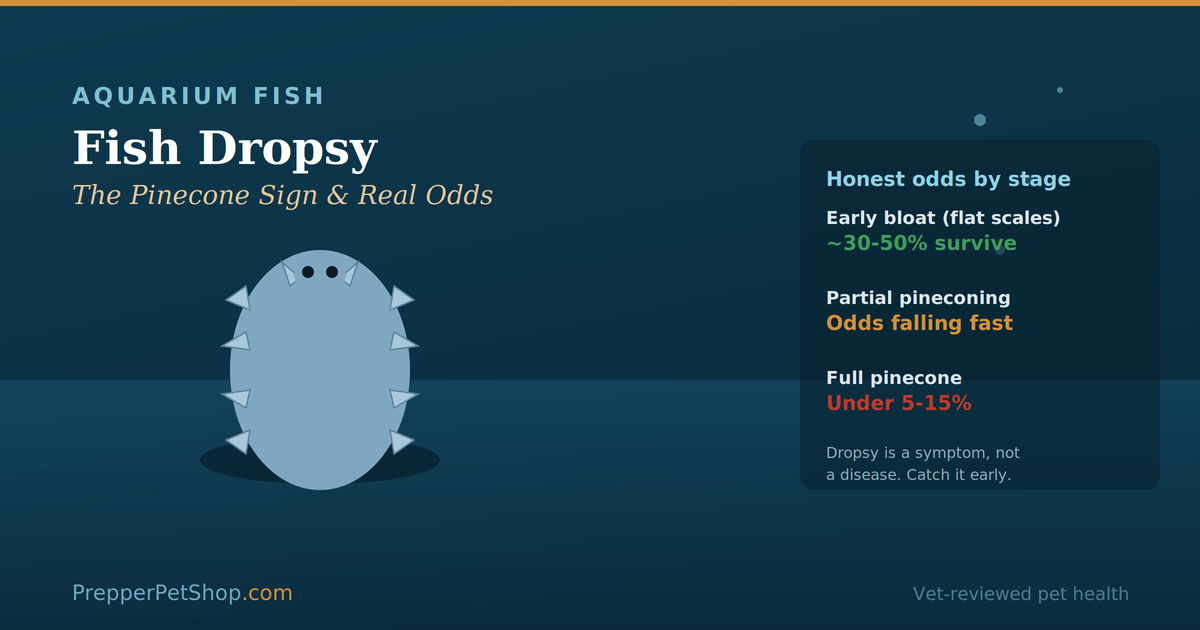
Most dropsy articles promise a cure and sell you a bottle. We'd rather be honest, because with dropsy the stage largely determines whether treatment has any real chance. And knowing that spares both you and your fish a lot of futile, stressful dosing. Here's what pineconing actually means, the real odds, and how to act.
Why dropsy is a symptom, not a disease
"Dropsy" is the aquarium word for the pinecone appearance, it's a description, not a diagnosis.3 Fluid accumulates inside the body cavity (ascites from liver/kidney failure, or edema from bacterial septicemia) and stretches the body wall from inside, so the scales flare outward.4 The usual root cause is a gram-negative bacterial infection (commonly Aeromonas) taking hold in a fish whose immune system is weakened by chronic stress or poor water.1 Crucially: a freshwater fish's kidneys work constantly to pump out water, so visible swelling means the internal damage is already advanced.3
What it looks like, and what it isn't
Dropsy signs: a swollen abdomen with raised, pineconed scales (look down from above), plus lethargy, bottom-sitting, appetite loss, sometimes bulging eyes (popeye), a curved spine, and surface-gasping.1
Not everything swollen is dropsy
Constipation / overfeeding bloat: belly swelling with scales still flat.1
Swim bladder issue: buoyancy problems (floating, sinking, tipping) without pineconing.3
One-sided swelling or a firm lump under flat scales: a different problem (tumor, cyst), not dropsy.3
The specific dropsy tell is raised, flared scales: flat scales mean look elsewhere.
The real odds, by stage
This is the part worth being honest about, because it should guide your decision:4
| Stage | What you see | Rough survival |
|---|---|---|
| 1. Bloat | Swollen belly, scales still flat, may still eat | ~30–50% |
| 2, Partial pineconing | Scales starting to stand out; lethargy, appetite loss | Falling fast |
| 3, Full pineconing | Whole-body raised scales, listing, popeye, rapid breathing | Under ~5–15%: often the euthanasia point |
Recognizing which stage you're in determines whether to treat aggressively or to let the fish go humanely.4 There's no shame in the latter. Late-stage dropsy is organ failure, and forcing treatment mostly prolongs suffering.
What to do
If caught early (bloat, flat scales)
- Move to a clean quarantine/hospital tank, reduces stress, protects tankmates, lets you monitor.2
- Pristine water — test and correct; poor water is a common trigger.
- Supportive care — Epsom salt baths are commonly described to help draw out fluid, done carefully; some keepers use aquarium antibacterials, though outcomes are uncertain even early.2
- Contact an aquatic vet if you can — dropsy reflects serious internal disease, and a vet can properly assess and prescribe.3
If fully pineconed
A note on antibiotics and resistance
It's tempting to throw antibiotics at dropsy, but beyond the poor late-stage odds, antibiotic resistance is a documented, serious problem in ornamental fish — one 2024 study of Aeromonas from ornamental fish found multidrug resistance in the majority of isolates.3 That's another reason to focus on prevention and early husbandry rather than reflexive dosing. See our honest guide on when aquarium antibiotics are actually warranted.
Prevention (the only reliable "cure")
- Pristine, stable water — regular testing and changes; the single biggest factor.
- Don't overcrowd or overfeed; keep temperature stable and correct.
- Quarantine new fish; feed a good varied diet to support immunity.
- Watch daily — catching bloat before pineconing is the only stage with decent odds.
For the broader picture, start at our sick fish identifier, and see betta and goldfish disease guides.
Frequently asked questions
What is dropsy?
A symptom, not a disease — internal fluid buildup (usually from organ failure driven by bacterial infection) that pineconess the scales. Visible swelling means advanced internal damage.
What does it look like?
Swollen belly with raised, pineconed scales (seen from above), plus lethargy, appetite loss, sometimes popeye and a curved spine.
Survival odds?
~30–50% at early bloat (flat scales), falling fast with partial pineconing, under ~5–15% at full pinecone — often the euthanasia point.
Dropsy vs constipation/swim bladder?
Dropsy = whole-body swelling with raised scales; constipation = belly bloat, flat scales; swim bladder = buoyancy problems, no pineconing. One-sided lump = something else.
Can it be cured?
Sometimes if caught as early bloat; once pineconed, rarely reversible. No reliable late-stage cure.
What should I do?
Early: quarantine, pristine water, supportive care (Epsom salt), ideally an aquatic vet. Fully pineconed and suffering: humane euthanasia is a kind choice.
Is it contagious?
The symptom isn't caught, but the causative bacteria can spread to stressed tankmates. Quarantine and fix water.
How we reviewed this article
This guide deliberately leads with honest, stage-based prognosis rather than a false promise of a cure, drawing on aquatic-health references, the Merck Veterinary Manual's staging of bacterial disease, and peer-reviewed data on antibiotic resistance in ornamental fish. Because dropsy so often ends in loss, we treat humane euthanasia as a legitimate, compassionate option rather than avoiding the subject. This article was medically reviewed by Dr. Carolina Gutiérrez-Rabadán (DVM, Aquatic Veterinary Medicine) on September 13, 2026. The reviewer verified the clinical accuracy of the guidance; PrepperPetShop is responsible for the final published text.
Sources & references
- Bettafish.org. Betta Fish Dropsy. Dropsy as secondary symptom, gram-negative/Aeromonas cause, pinecone identification from above, low survival. bettafish.org
- Betta Care Fish Guide. Dropsy in Betta Fish. Early-vs-late treatability, quarantine tank, Epsom salt baths, treatments don't guarantee a cure. bettacarefishguide.com
- Aquatic veterinary reference. Betta/Goldfish Dropsy. "Description not diagnosis," freshwater osmoregulation point, distinguishing one-sided swelling, ornamental-fish Aeromonas multidrug resistance (2024 study), see a fish vet. aquatic reference
- Clinical staging reference (Merck-cited). Betta Dropsy staging. Stage 1 bloat ~30–50%, stage 3 full pinecone under ~5–15%, euthanasia point, ascites vs edema mechanism. staging reference
- Aquarium Pharmaceuticals / general aquatic references. Dropsy across species (goldfish, betta, guppy), isolate + supportive care, euthanasia in severe cases, prevention via clean water. aquariumpharm.com
Sources current as of September 2026. Educational content for aquarium keepers. Dropsy reflects serious illness — consult an aquatic veterinarian where possible.