Aquarium Antibiotics: When You Actually Need Them (Water First, Meds Last)
Search results and store shelves push a bottle for every symptom. We'd rather give you the honest framework a careful fishkeeper (or an aquatic vet) actually uses, because the wrong reflex here hurts your fish and your whole tank. Here's when antibiotics genuinely help, when they don't, and how to use them without doing damage.
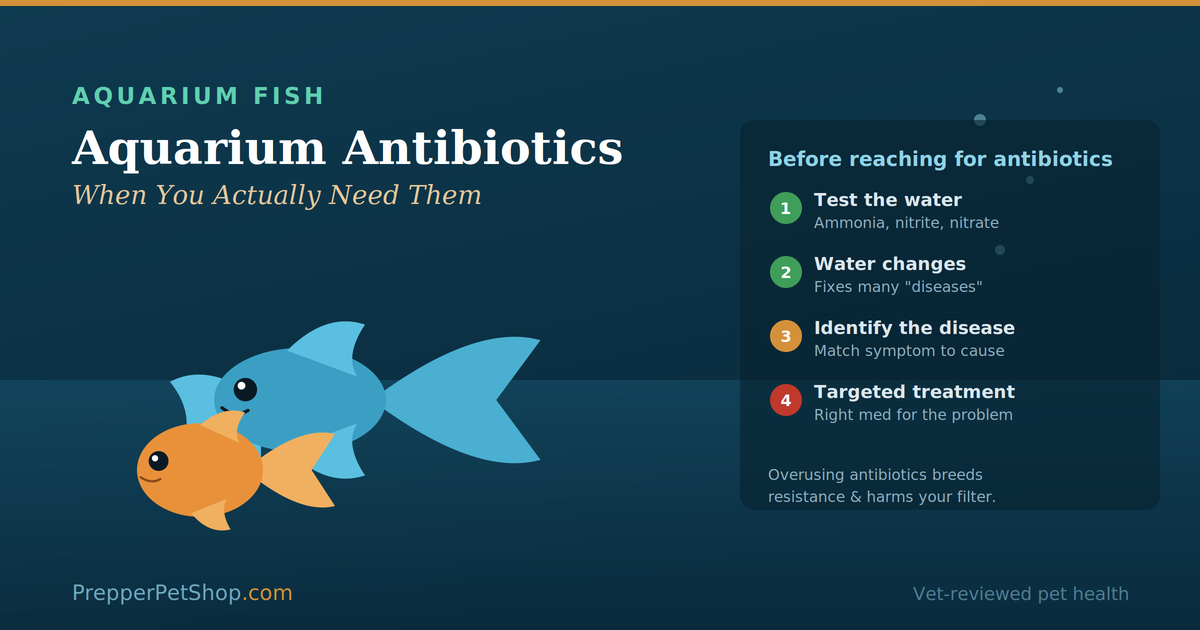
The ladder: what to do before antibiotics
- Test the water. Ammonia (0), nitrite (0), nitrate (low), temperature (correct and stable). Poor water is the root of most fish illness because it stresses the immune system and lets opportunistic organisms take over.1
- Do water changes. Correcting conditions resolves or halts a large share of "diseases" on its own. No medication needed.2
- Identify the actual disease. Match the specific signs (see our sick fish identifier). This determines whether you even need an antibiotic.
- Targeted treatment, only if a real bacterial infection persists. And ideally with an aquatic vet's input.
Antibiotics vs. anti-parasitics vs. antifungals
Confusing these is a classic, costly error, each treats a different category, and using the wrong one wastes days while the fish declines:
| Problem type | Examples | What treats it |
|---|---|---|
| Bacterial | Fin rot (advancing), ulcers, columnaris, septicemia | Antibacterial / antibiotic |
| Parasitic | Ich (white spots), velvet, flukes | Anti-parasitic: antibiotics do nothing |
| Fungal | Cottony white growths | Antifungal |
| Environmental | Ammonia stress (red streaks), temperature shock | No medication. Fix the water |
When antibiotics are genuinely warranted
Reserve them for a real, identified bacterial infection that isn't resolving after you've corrected the water, for example:
- Advancing fin rot with spreading red/black edges that keeps progressing despite good water (see our fin rot guide).
- Ulcers or open sores on the body.
- Bacterial septicemia: red streaks that persist after the water is corrected (fresh ammonia streaking should resolve when you fix the water, not with antibiotics).
- Columnaris (cottony mouth/body patches). Bacterial and fast-moving.
Even here, the Merck Veterinary Manual frames bacterial outbreaks as stress-driven, so the antibiotic treats the infection while fixing the environment prevents the next one.1
How to use them without wrecking your tank
- Treat in a hospital/quarantine tank when possible, protects your main tank's biological filter and other fish.2
- Remove activated carbon from the filter first, it absorbs medication and neutralizes the dose.
- Dose exactly for your tank volume — measure; don't eyeball.
- Do the recommended water changes between doses.
- Complete the full course — stopping early when the fish "looks better" lets surviving bacteria rebound and develop resistance.
- Watch your parameters — if you must dose the main tank, monitor for an ammonia/nitrite spike from filter damage.
The resistance problem (why this matters beyond your tank)
When to involve an aquatic vet
Fish medicine is a real veterinary specialty. Involve an aquatic vet for a valuable fish, a whole-tank outbreak, or any infection that isn't responding — they can confirm whether a bacterial infection is actually present (sometimes with a swab or culture) and recommend the right drug, rather than leaving you guessing with a shelf product.2
The bottom line
Antibiotics are a real tool for real bacterial infections — but they're the last rung of the ladder, not the first. Test your water, fix it, identify the actual problem, and reach for antibiotics only when a genuine bacterial infection demands them. Your fish, your filter, and everyone's future ability to treat these infections all benefit. Start any sick-fish situation at our symptom identifier.
Frequently asked questions
When does a fish actually need antibiotics?
Only for a genuine bacterial infection not resolving after corrected water — advancing fin rot, ulcers, persistent septicemia, columnaris. Not for parasites or water problems.
Why not just add antibiotics when a fish looks sick?
Most problems are water or parasites, so antibiotics often do nothing but harm — crashing your filter, stressing the fish, wasting money, and breeding resistance. Test water first.
Do they kill the biological filter?
Many can — the filter is bacteria too. Treat in a hospital tank, remove carbon, and monitor for ammonia spikes.
What to do before antibiotics?
Test water, do water changes, identify the actual disease. Only then use a targeted antibacterial if a real infection persists.
How to use them correctly?
Hospital tank, remove carbon, dose exactly, water changes between doses, finish the full course, match the product to the identified disease.
Is resistance really a problem?
Yes — a 2024 ornamental-fish study found multidrug resistance in most Aeromonas isolates. Reserve antibiotics for genuine infections and finish the course.
Antibiotics vs anti-parasitics?
Different categories — antibiotics for bacteria, anti-parasitics for ich/velvet/flukes, antifungals for fungus. Wrong category wastes days.
How we reviewed this article
This guide deliberately frames antibiotics as a last resort for identified bacterial infections rather than a first response, following the Merck Veterinary Manual's stress-driven model of fish disease and peer-reviewed data on resistance in ornamental fish. It's written to reduce harmful over-medication, not to encourage purchases. This article was medically reviewed by Dr. Carolina Gutiérrez-Rabadán (DVM, Aquatic Veterinary Medicine) on September 14, 2026. The reviewer verified the clinical accuracy of the guidance; PrepperPetShop is responsible for the final published text.
Sources & references
- Merck Veterinary Manual (via aquatic-health references). Bacterial diseases of fish are strongly tied to stressors (water quality, oxygen, handling); correcting environment is central. merckvetmanual.com
- Chewy (aquatic health). Water-quality-first treatment, hospital/quarantine tank, remove carbon before dosing, when to seek expert help. chewy.com
- Peer-reviewed study of Aeromonas from ornamental fish (2024): multidrug resistance in the majority of isolates; hobby over-use contributes to resistance. resistance data summary
- Aqulator. How to Treat Fin Rot. Correct antibacterial-use protocol: remove carbon, dose to volume, water changes between doses, finish the full course. aqulator.com
- Petco. Fin Rot: Causes, Symptoms & Treatment. Assess environment before medicating; distinguishing bacterial from environmental causes. petco.com
Sources current as of September 2026. Educational content for aquarium keepers. Not a substitute for an aquatic veterinarian's diagnosis.