Egg Bound Chicken: Emergency Treatment and the 24-Hour Rule
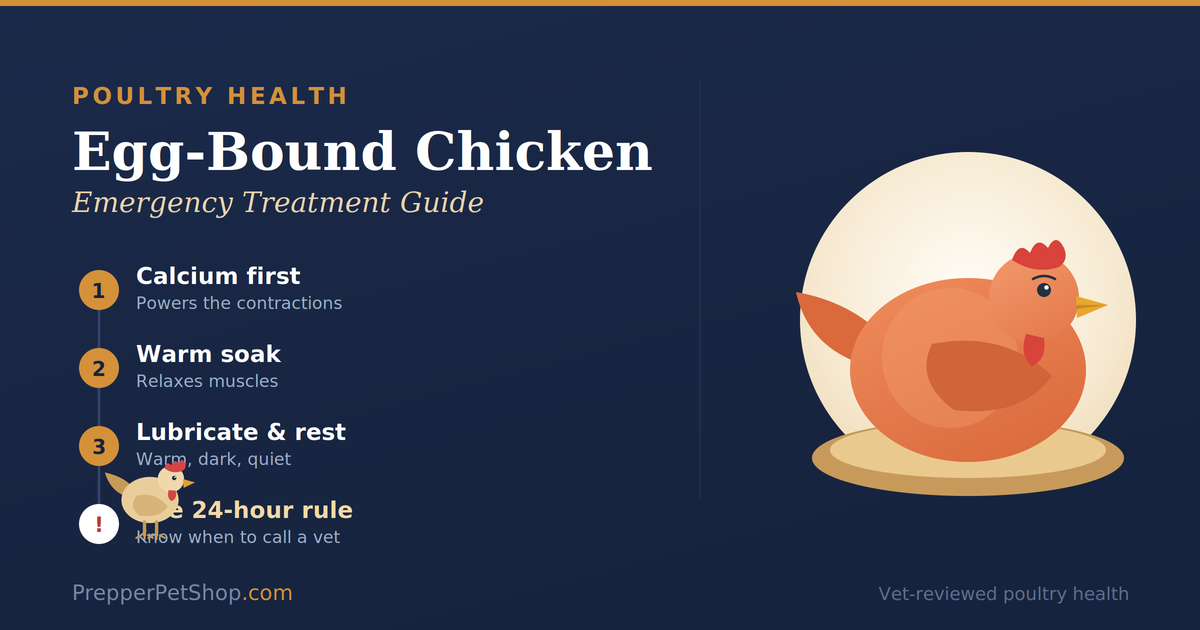
If you are reading this with a hen hunched in the nest box, straining and getting nowhere, you do not need a biology lecture — you need to know what to do in the next hour. This guide gives you that first, then explains the why underneath it so you can make good calls as her situation changes. Everything clinical here is drawn from veterinary references, not aggregated hobby advice, and each load-bearing claim is numbered to a source at the foot of the page.
Egg binding is not rare. It is one of the most common true emergencies in backyard hens, and it turns up most in three groups: young pullets laying their first eggs, older hens whose muscles have weakened, and high-production or heavy breeds like Silkies.2 The good news is that when you catch it early, most hens respond to exactly the home care below.
How to tell if your chicken is egg bound
An egg bound hen looks distinctly unwell, and the signs tend to appear in a rough order of how obvious they are. You usually will not see all of them — two or three together, in a hen who should be laying, is enough to act on:
- She sits in the nest box for hours with nothing to show for it, or keeps returning to it and straining.
- She strains visibly — you may see her tail pumping or her whole body pushing in rhythm.
- She stands like a penguin — unusually upright, waddling with her legs set wide apart, because normal posture hurts.
- She is lethargic and fluffed up, ignoring food and treats she would normally run for.
- Her abdomen feels firm and full. Gently feeling just above the vent, you may be able to feel the egg itself.
- Her droppings shrink or stop, or turn small and watery, because the egg is pressing on her gut.
- Her comb may look pale rather than its normal red.
One honest caveat: several of these signs — hunching, low energy, a pale comb, straining — show up in other problems too. A broody hen, vent gleet, or internal laying can look similar. Egg binding is worth treating first because it is common and fast-moving. But if she does not improve as expected, stay open to other causes.
The egg bound chicken treatment protocol, step by step
This is the sequence to run at home. It is deliberately gentle — every step is something that helps her pass the egg herself, because that is the only safe way to get it out at home.
Step 1 — Calcium first
Calcium is what powers the muscle squeezes that push an egg out. Too little calcium is the most common reason a hen gets stuck in the first place.1 Giving it is often what tips a stuck egg loose.
Give a liquid calcium supplement by mouth using a syringe (no needle). If you do not have liquid calcium on hand, dissolve half a plain 500 mg Tums tablet (calcium carbonate, regular strength) in a small amount of water and syringe that in instead. A calcium-rich snack like plain yogurt or crushed oyster shell can help too, but the liquid or dissolved form acts faster.
Step 2 — Warm soak
Fill a basin or sink with warm water — about 100–102 °F, comfortably warm on the inside of your wrist, never hot. Add roughly 2 tablespoons of Epsom salt per gallon. Lower her in so her abdomen and vent are submerged, support her gently, and let her sit for 20–30 minutes; most hens stop struggling and settle after a minute or two. The warmth relaxes the oviduct muscles and the Epsom salt helps ease swelling.2 Afterward, dry her thoroughly with a towel and keep her somewhere warm while she finishes drying — a wet hen chills fast.
Step 3 — Lubricate the vent
Once she is dry, apply a water-based lubricant (plain KY-type jelly) or a little olive oil gently around and just inside the vent opening. This reduces friction so the egg can slide the last stretch.2
Step 4 — Warmth, dark, and quiet
Move her to a warm (about 80–85 °F), dark, quiet recovery space. A dog crate with a towel draped over it works well, with a heating pad on low under half the floor so she can move off the heat if she wants. Darkness lowers her stress and the warmth keeps her muscles relaxed.7 One important point from avian practice: do not sedate her or try to knock her out to "relax" her — she needs active muscle contractions to lay, and sedation works against that.5
Step 5 — Wait, then repeat once
Give it time. Many hens pass the egg within 2–6 hours of this routine. If she has not passed it after about 6 hours, repeat the calcium dose and the warm soak one more cycle. And then watch the clock closely, because the next section is the most important judgment call you will make.
The 24-hour rule: when it becomes a vet emergency
This is the line that separates "manageable at home" from "she needs a professional now." The veterinary guidance is consistent. If the egg has not passed within about 24 hours, or she is getting worse faster than that, home care has done what it can. Past that point, the risk of serious harm climbs steeply.8
Stop home treatment and get veterinary help right away if any of these are true:
- 24 hours have passed with calcium, soaks, and lubrication and still no egg.
- She is severely weak, cannot stand, or her legs seem paralyzed — a sign the egg is compressing pelvic nerves.
- You see a prolapse — red or pink tissue protruding from the vent.
- She crashes suddenly or develops a foul-smelling discharge, which can mean the egg has broken inside her.
A vet has options you cannot use safely at home. They can remove the egg by hand under sedation. They can drain it through a needle and take it out in pieces (called ovocentesis). They can give fluids and pain relief, and operate in the worst cases.5 Calling a vet at hour 24 is not a failure of your home care — it is the correct next step in it.
What to have ready before it happens
Egg binding moves too fast to shop for supplies mid-emergency. A hen keeper's kit worth having on the shelf: a liquid calcium supplement (or plain Tums), Epsom salt, a water-based lubricant, a spare towel, and the phone number of a vet who will actually see poultry — many small-animal clinics will not, so find that out on a calm day, not this one.
Why it happens — and how to make it rarer
Understanding the causes is what turns a one-time scare into a flock you rarely have to rescue. The common contributors:12
- Calcium deficiency — by far the most common, and the most preventable.
- Oversized or double-yolked eggs that are simply too big to pass easily.
- Obesity, which weakens the muscle tone she needs to lay.
- Very young hens pushed into laying before their bodies are ready, and older hens with naturally weaker muscles.
- Dehydration and stress, from predators, overcrowding, or heat.
- Long daylight hours in spring and summer, which overstimulate laying — egg binding genuinely is more common in the warm months.3
Prevention, in order of impact:
- Offer free-choice oyster shell at all times, in a separate dish from feed, and let hens self-regulate their calcium. This one habit prevents more egg binding than anything else.
- Keep fresh water available constantly — hydration is part of healthy laying.
- Avoid obesity by limiting scratch and treats to a small fraction of the diet.
- Reduce stressors — secure the coop against predators, avoid overcrowding, and handle nervous hens less.
Frequently asked questions
How long can a chicken be egg bound before she dies?
Most hens that die from egg binding do so within 24 to 48 hours of the egg becoming stuck. That is why the 24-hour mark is the key decision point: past roughly a day without passing the egg, the risk of a torn oviduct, prolapse, or circulatory damage rises sharply and it becomes a veterinary emergency.
What is the fastest home remedy for an egg bound chicken?
The fastest reliable combination is oral calcium followed by a warm soak. Calcium drives the oviduct muscles to contract, and 20 to 30 minutes in warm water relaxes the surrounding muscles. Caught early, many hens pass the egg within 2 to 6 hours of that pairing.
How much calcium do you give an egg bound hen?
A common home approach is a liquid calcium supplement by mouth, or half a crushed 500 mg Tums (calcium carbonate) tablet in a little water for a standard hen. Published avian dosing for calcium gluconate is roughly 50 to 100 mg/kg. Because product strengths vary and injectable calcium carries a cardiac risk, oral is the safer home route and injections are a veterinarian's job.
Should I pull the egg out of my egg bound chicken?
No. Do not pull or push the egg. If the shell breaks inside the oviduct it can cause peritonitis, which is frequently fatal. Manual or surgical removal is done by a vet under sedation. At home, help her pass it herself with calcium, warmth, and lubrication.
Can an egg bound chicken still poop?
Often not normally. The stuck egg presses on the intestines and can reduce or block droppings, so small watery droppings or none at all is a common sign. The same pressure compresses pelvic nerves and vessels, which is why the condition is time-sensitive.
Is a warm bath good for an egg bound chicken?
Yes. A warm soak around 100 to 102 degrees Fahrenheit for 20 to 30 minutes, ideally with Epsom salt, is one of the most consistently recommended steps. The warmth relaxes the oviduct muscles and the Epsom salt eases swelling. Keep her vent submerged and dry her fully afterward.
Why do chickens become egg bound?
The most common cause is calcium deficiency, which weakens the contractions needed to lay. Other causes include oversized or double-yolked eggs, obesity, first-time or elderly layers, dehydration, and stress. Long daylight hours in spring and summer raise the risk further.
Can egg binding fix itself?
A mild early case sometimes resolves on its own, but you should not wait to find out. Because it can turn fatal within a day or two, start supportive treatment as soon as you suspect it rather than hoping it passes.
Does an egg bound chicken need antibiotics?
Not for the binding itself — antibiotics do not help a hen pass a stuck egg. They only matter if a complication develops, such as infection from a broken egg, and that is a call for a veterinarian who has examined her.
How we reviewed this article
This guide is built from veterinary references and the published guidance of avian and poultry clinicians — the Merck Veterinary Manual, Plumb's Veterinary Drug Handbook, and peer-reviewed and practitioner sources — rather than aggregated hobby forums. Every clinical claim above is numbered to a source below. Dosing is presented as a sourced range with its safety caveats, never as a personal prescription; for an individual sick hen, your veterinarian's judgment comes first. This page is scheduled for review and sign-off by a licensed veterinarian; the reviewer's name and date will appear here once that review is complete.
Sources & references
- Merck Veterinary Manual. Egg-Bound or Impacted Oviducts in Poultry. Cause and risk factors (hypocalcemia, oversized eggs, young/obese hens). merckvetmanual.com
- poultryDVM. Egg Binding. Condition overview, supportive care (warmth, calcium, lubrication), and the 24-hour escalation threshold. poultrydvm.com
- Merck Veterinary Manual. Egg-Bound or Impacted Oviducts in Poultry. Seasonal (spring/summer) prevalence and mass-effect pressure on surrounding structures. merckvetmanual.com
- Plumb's Veterinary Drug Handbook, avian calcium gluconate dosing (50–100 mg/kg range), as reproduced from the avian therapeutic-agents formulary. Range and route caveats. Calcium gluconate (avian) reference
- dvm360 Proceedings. How I Treat Psittacine Egg Binding and Chronic Laying. Clinical escalation: fluids, calcium gluconate 100 mg/kg IM, ovocentesis, and avoiding sedation. dvm360.com
- Inquisitive Vet / avian clinical guidance. Egg Binding in Birds. Hydration alongside calcium; injectable-calcium cardiac risk; keep in a warm, dark, quiet environment and avoid sedation. inquisitivevet.com
- Merck Veterinary Manual. Reproductive Diseases of Pet Birds. Post-event depression up to 24 hours and risk of a second egg the following day (rationale for warm, quiet recovery and monitoring). merckvetmanual.com
- poultryDVM. Egg Binding — treatment timeline. If the egg is not passed within 24 hours or signs worsen, immediate veterinary care is essential. poultrydvm.com
Sources current as of September 2026. This article is educational and is not a substitute for hands-on veterinary care. If your hen is in distress, contact a veterinarian.